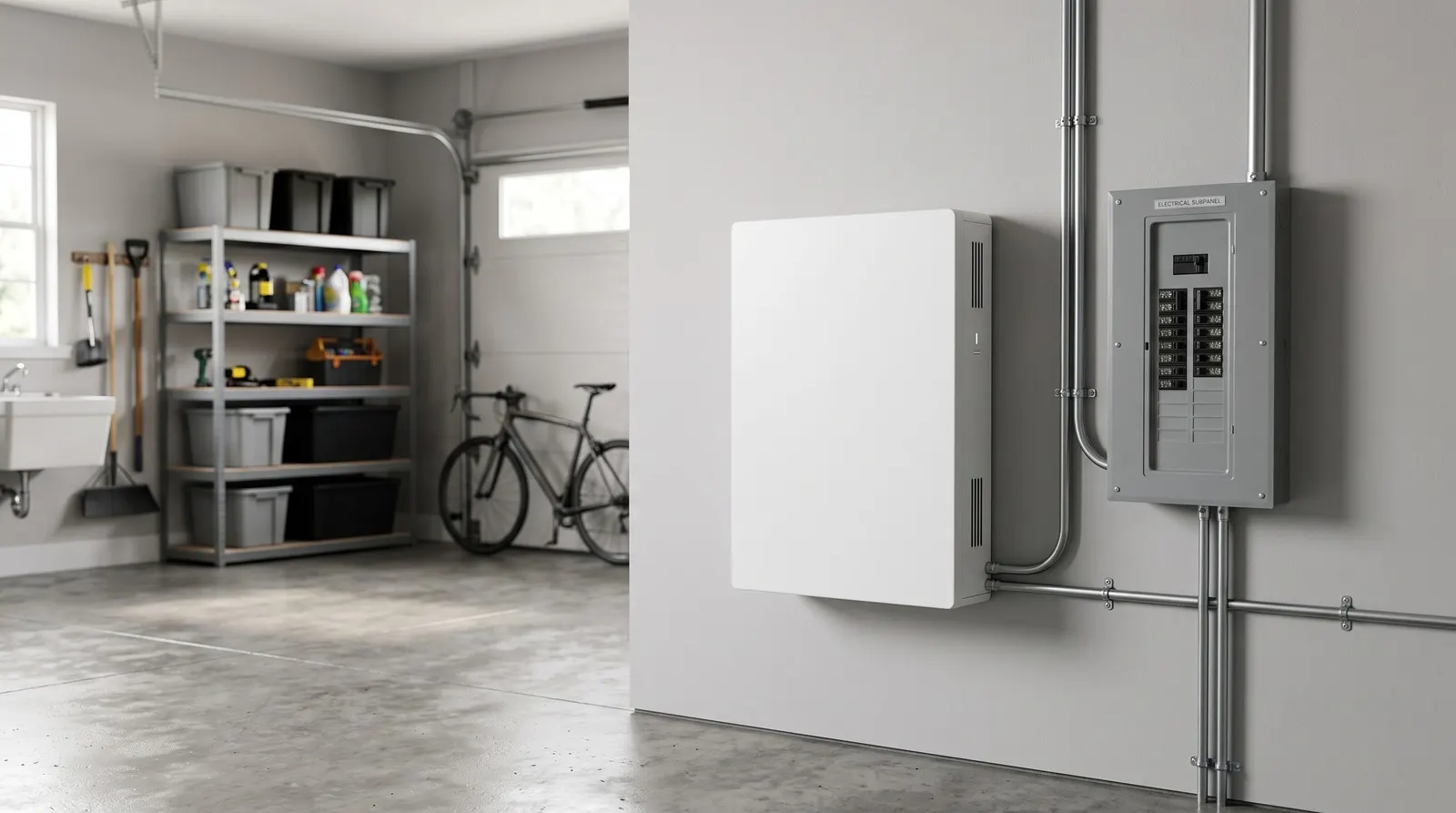
Home batteries have gone from rare to routine: in California, most new solar homes now get one. They are also expensive, and in 2026 there is no federal credit to soften the price. This guide uses public records to show who is buying batteries, what they paid, and when one pays off.
Who is actually buying batteries
In the public installation records compiled by Lawrence Berkeley National Laboratory (Tracking the Sun), the share of new home solar systems installed with a battery grew slowly until 2023 and then took off:
| Year | Home systems with a battery (all states in the records) | California |
|---|---|---|
| 2017 | 0.4% | 0.6% |
| 2019 | 3.9% | 6.1% |
| 2021 | 8.0% | 12.9% |
| 2023 | 10.1% | 15.7% |
| 2024 | 34.4% | 60.1% |
| 2025 | 44.9% | 71.5% |
The jump follows California’s net billing tariff, which from April 2023 cut what new solar customers earn for exported power. Storing midday solar for the evening became the main way to make a system pay there. Fewer 2024 and 2025 systems are in the records so far, because some utilities report late, so the exact shares may still move.
In 2023–2025, Tesla supplied 50% of the batteries in the records that name the brand, followed by Enphase (19%), SolarEdge (14%) and LG (7%). The median battery stored 13.5 kWh, the capacity of a single Powerwall; half stored between 10 and 19 kWh.
The Energy Information Administration’s monthly utility reports (Form EIA-861M) show where batteries paired with home solar are concentrated, as of July 2026:
| State | Homes with solar | Paired battery capacity | Per solar home |
|---|---|---|---|
| California | 2,272,639 | 3,784 MW | 1.7 kW |
| Hawaii | 108,289 | 340 MW | 3.1 kW |
| Arizona | 335,129 | 216 MW | 0.6 kW |
| Utah | 84,627 | 101 MW | 1.2 kW |
Hawaii stands out because exporting solar power there earns little, so storing it for the evening is where the value is. The same logic now applies in California under net billing.
What batteries cost
Looking at whole systems bought by the homeowner in 2023–2025, solar with a battery had a median price of $39,500, against $27,000 for solar alone. Part of that gap of about $12,500 comes from size, since homes adding a battery also installed bigger arrays (7.8 kW against 6.6 kW).
The records price the battery on its own for 16,778 home systems installed in 2023–2025, almost all in California. The median was about $22,400, roughly $1,200 per kWh of storage, before incentives: $22,000 in 2023, $21,000 in 2024 and $24,500 in 2025.
Quotes you get today may differ from these records. Use them as a reference: if a quote for one 13.5 kWh battery is far above the $22,400 median installed, ask why.
What a battery does for you
Backup during outages
A grid-tied solar system without a battery shuts down when the grid goes down, so line workers aren’t exposed to power flowing back from your roof. A battery, with the right switch, keeps selected circuits (or the whole house) running and lets the panels recharge it during the day.
Moving solar power to the evening
With time-of-use rates, electricity costs the most in the late afternoon and evening, just as solar output fades. A battery stores midday solar and releases it during those hours.
Getting more from your solar when exports pay little
Under California’s net billing tariff and similar programs, power you send to the grid earns far less than the retail rate. Storing it and using it at home is often worth more than exporting it.
Chemistry and models
Most home batteries now use lithium iron phosphate (LFP) cells, which tolerate heat and many charge cycles well. That includes the Tesla Powerwall 3 (13.5 kWh, up to 11.5 kW continuous, with a built-in solar inverter), Enphase’s IQ batteries and FranklinWH. The older Powerwall 2, still on many homes, used a nickel-manganese-cobalt (NMC) chemistry and delivers about 5 kW.
What to compare between models:
- Usable capacity (kWh): how much energy it stores.
- Continuous power (kW): how much it can run at once. This decides whether it can start your air conditioner.
- Warranty: most cover 10 years with a minimum remaining capacity, often 70%.
- Compatibility: some batteries work only with the same brand of inverter.
Does a battery pay for itself?
Take a time-of-use example: you store 10 kWh of solar a day and use it when grid power costs $0.45 per kWh instead of exporting it for $0.10.
- Daily savings: 10 kWh × ($0.45 − $0.10) = $3.50
- Yearly savings: about $1,280
- Payback on a $13,000 quote: about 10 years
- Payback at the $22,400 median in the records: about 18 years
Before 2026, the federal credit took 30% off the price. Without it, a battery bought mainly to save money only works where the gap between peak rates and export credits is wide, or where a utility or state program pays you to share the battery. In places with full retail net metering and flat rates, a battery rarely pays for itself; you are buying backup power.
The verdict
- Worth it if outages are frequent or long where you live, or someone at home depends on powered medical equipment.
- Worth pricing out if your utility has steep time-of-use rates or pays little for exported solar, as in California and Hawaii.
- Hard to justify on savings alone if you have full net metering and flat rates.
For what the rest of a solar system costs, see our guide to solar panel prices, and our Tesla Powerwall guide for what installation involves.
Sources
- Lawrence Berkeley National Laboratory, Tracking the Sun, 2026 edition, records through 2025 (CC BY 4.0): home systems on existing homes, 2017–2025. Calculations by Solar Power Fix.
- U.S. Energy Information Administration, Form EIA-861M, net metering, July 2026.
- Tesla, Powerwall 3 datasheet.
Frequently Asked Questions
How much does a home solar battery cost?
In public installation records for 2023–2025, solar systems installed with a battery had a median total price of $39,500, against $27,000 without one, and the median battery stored 13.5 kWh. Where the records price the battery on its own, mostly in California, the median was about $22,400, or roughly $1,200 per kWh of storage.
How long can a solar battery power my house?
A 13.5 kWh battery can run essential loads (refrigerator, lights, Wi-Fi, a few outlets) for roughly a day. Central air conditioning or electric heat can drain it in a few hours. If your panels recharge it during the day, you can keep essentials running through a longer outage in good weather.
Do I need a battery to go solar?
No, though it is becoming the norm. In 2025, about 45% of new home solar systems in public records included one, and 72% in California, up from 10% and 16% in 2023. Without a battery, the panels shut off during a grid outage.
Can I still get a tax credit for a battery in 2026?
Not as a homeowner buying it. The 30% residential credit (Section 25D) that covered batteries ended on December 31, 2025. Some states and utilities still pay for batteries, often in exchange for letting the utility draw on them during peak demand.